OrderGuard
通过置换边缘化降低 LLM 判题、重排和工具选择对候选顺序的敏感性。
候选项的顺序本身并不是有意义的信号——但很多 LLM 流水线会在不经意间把它当成信号。
当你用 LLM 从 N 个候选中选 1 个(LLM-as-a-judge、RAG reranking、Agent 的 tool/action selection),只要把同一组候选换个排列顺序,最终赢家就可能改变,导致系统不稳定、评测噪声大、线上难复现。
OrderGuard 是一个无需训练的推理期包装器:通过对候选顺序做(近似)置换边缘化(marginalize over permutations),使用强约束的 logprob forced-choice 打分 + 自适应 early-stop,显著降低“顺序敏感性”,并在多选 benchmark 上带来稳定的准确率增益。
核心思想
- 置换群 group-averaging(推理期不变性): 把候选顺序当作干扰变量,通过多个置换的打分聚合来边缘化顺序。
- 低方差设计(LaTIn): 用位置均衡的循环调度(Latin-square 风格),相比随机置换方差更低。
- 自适应停止: 用 JS divergence 判断聚合分布是否稳定(阈值触发 early-stop),把更多 test-time compute 分配给“难样本”。
关键结果(Qwen3,可复现)
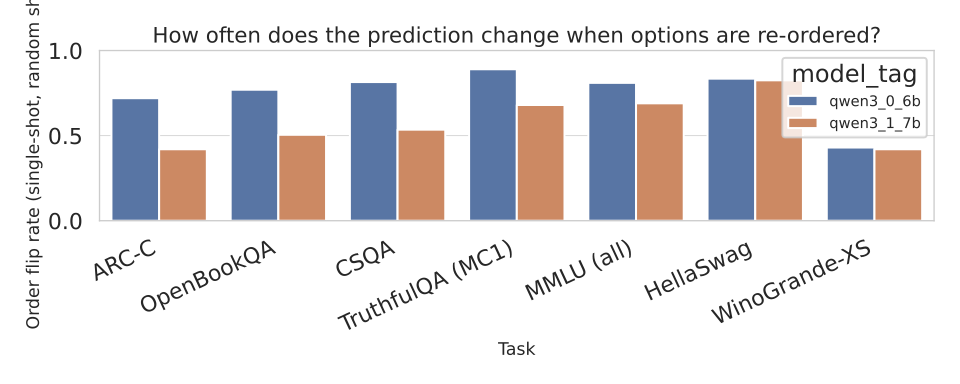
- 单次(single-shot)的“从列表里选一个”对重排极其不稳定:只做 10 次随机重排,赢家翻转比例可达 58–75%(视模型而定)。
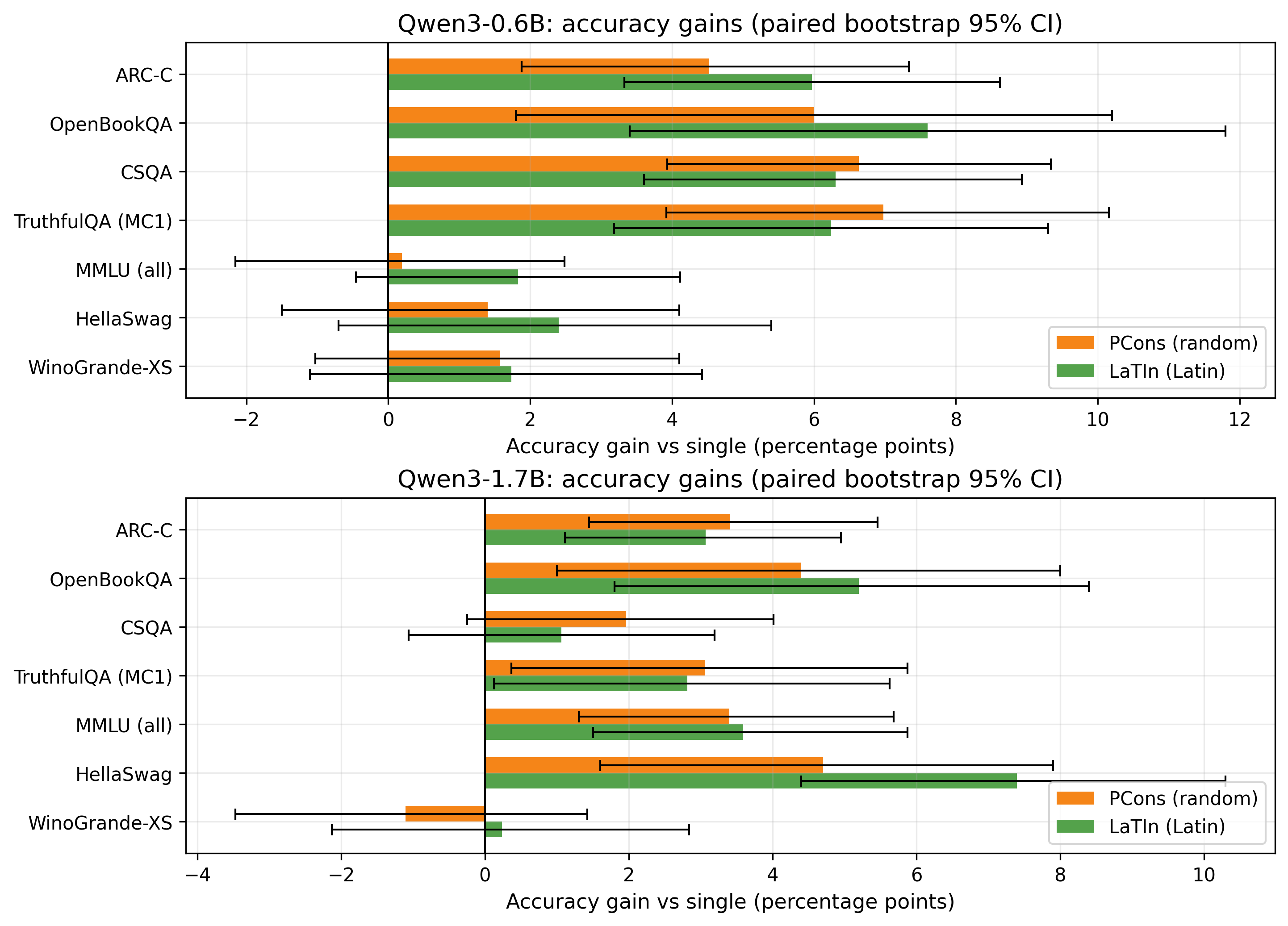
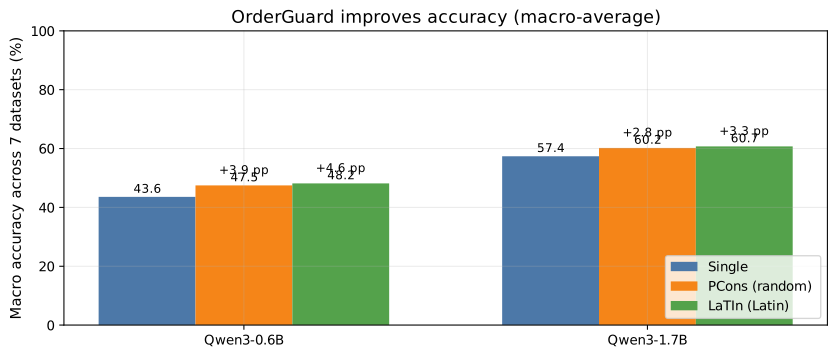
- OrderGuard 在 Qwen3 上把宏平均准确率提升 +2.8 到 +4.6 个百分点,单个数据集最高可到 +7.6pp。
单个数据集上最大的提升(相对 single 的准确率增益,绝对百分点 pp):
| 模型 | 数据集 | 提升 | 方法 |
|---|---|---|---|
| Qwen/Qwen3-0.6B | OpenBookQA | +7.6 pp | LaTIn |
| Qwen/Qwen3-0.6B | TruthfulQA(MC1) | +7.0 pp | PCons |
| Qwen/Qwen3-0.6B | CSQA | +6.6 pp | PCons |
| Qwen/Qwen3-1.7B | HellaSwag | +7.4 pp | LaTIn |
| Qwen/Qwen3-1.7B | OpenBookQA | +5.2 pp | LaTIn |
| Qwen/Qwen3-1.7B | MMLU(all) | +3.6 pp | LaTIn |
最小 API
from orderguard.methods import latin_consensus
from orderguard.modeling import load_lm

lm = load_lm("Qwen/Qwen3-1.7B", torch_dtype=None)

question = "Pick the best next tool for: extract the answer from a table."
choices = [
    "WebSearch: use the browser to find information online.",
    "Calculator: do arithmetic precisely.",
    "TableParser: read structured tables and extract fields.",
    "WriteCode: write a short script to compute the result.",
]

res = latin_consensus(lm, question, choices, max_perms=7, min_perms=3, js_eps=0.005, seed=0)
print("winner:", choices[res.pred_index], "perms_used:", res.meta["perms_used"])